
Lubbock City Directory Shelf and Runs
Two verified publisher runs give the Lubbock city directory collection its clearest backbone. Hudspeth’s Lubbock City Directory spans 1930 through 1972 in the National Register bibliography, followed by R.L. Polk’s Lubbock City Directory from 1973 through 2003. Earlier examples appear in library genealogy discovery material, but their complete shelf sequence has not been verified. Treat each volume as a year-specific source. The research value is in comparing the printed entry with nearby editions, not assuming an unlisted year never existed.
| Collection | Years | Where Held | Access |
|---|---|---|---|
| Hudspeth’s Lubbock City Directory | 1930–1972 | Mahon Library and local historical collections | Check the volume and year on site; selected 1934 and 1935 photocopies are documented |
| R.L. Polk’s Lubbock City Directory | 1973–2003 | Local library and historical collection named in the bibliography | Later household and business trail; verify annual gaps |
| Earlier and other Lubbock directories | 1910 and selected 1926, 1929–1944 examples | Library genealogy databases and archives | Confirm the exact edition before relying on it |
| Telephone and criss-cross directories | Years not fully published | Mahon and TTU reference or archive holdings | Address-to-occupant bridge, subject to edition limits |
A Lubbock city directory is strongest when its gaps are kept visible. The published record does not establish a complete official shelf list, and the digitized collection does not prove that every local edition is online. When a desired year is absent, ask for the city, directory type, and year rather than substituting a general Texas search result.
Note: Record the publisher, year, and page before comparing an entry with another Lubbock directory or a later primary record.
Hudspeth Lubbock City Directories
The Hudspeth run covers the long middle portion of Lubbock’s verified directory history, from 1930 to 1972. It is a practical starting point for a family that appears in an early or mid-century local address. The bibliography also identifies Lubbock Sanborn editions for 1926, 1931, 1940, and 1957, which can help place a directory address in its built setting. A Sanborn sheet does not name residents, so use it for the structure, block, and address context, then keep the city directory as the people-bearing source.
The transition to Polk around 1973 matters. A household may seem to disappear if the search stops at one publisher boundary or if a surname has a variant spelling. Follow a surname, given-name form, spouse, occupation, and street address through the last Hudspeth edition and the first available Polk edition. That approach is more reliable than treating a single listing as a complete household census.
Polk Lubbock City Directory Years
R.L. Polk’s Lubbock City Directory run is verified from 1973 through 2003. These volumes can extend a household or business trail after the Hudspeth series ends. They can also reveal the point where an address begins to be used for a different listed person or enterprise. Check the front matter in the specific book first, because entry symbols and abbreviation conventions can change by publisher and edition.
For an older address that no longer fits the current street pattern, pair the printed address with a lot survey or map from the Texas Tech Southwest Collection. Its Lubbock holdings include maps, cemetery references, neighborhood files, and lot surveys for the 1920s through 1960s. That local bridge is especially useful for Original Town, Overton, and McCrummens, where lot and block changes can make a modern address a poor search key.
How Lubbock City Directory Entries Read
Read a Lubbock city directory entry as a compact record with its own rules. A typical person entry may carry a surname and given name, spouse notation, occupation or business, street address, a widow or household note, and sometimes a status mark. The exact form is edition-dependent. Do not expand a mark by memory or borrow a key from another year. Photograph or transcribe the abbreviation key at the front of the volume before interpreting it.
| Name | Surname and given-name form, which may differ from a census or deed spelling. |
|---|---|
| Household notation | A spouse in parentheses, a widow note, or another household clue when printed. |
| Occupation or business | An occupation or business reference that can separate people with the same name. |
| Address | Street number and name, then test it in the edition’s street or criss-cross section. |
| Marks and abbreviations | Status, telephone, building, or other marks only as defined in that volume’s own key. |
- Criss-cross directory
- An address-ordered section that can lead from a street number to a listed occupant or business.
- Householder index
- An alphabetical arrangement centered on the named household listing, not a full roster of every person in a home.
- Abbreviation key
- The publisher’s legend, usually in the front matter, that controls the meaning of marks in that edition.
Capture the volume, year, and page along with the entry. A city directory is a snapshot of who or what was listed at one time, not a deed, a census enumeration, or proof of an ongoing relationship to the address.
Where Lubbock Directory Research Happens
Mahon Library’s electronic-resources page is the first local access point for genealogy databases, digitized yearbooks, and assistance with home-login questions. Most genealogy and reference materials do not circulate, but the library permits photocopies of an index, table of contents, or specified pages. The stated print rate is 15 cents per page as of January 8, 2024. If a local volume is incomplete, interlibrary loan is another route, with the library noting a usual four-to-six-week arrival and a three-dollar item charge when received.
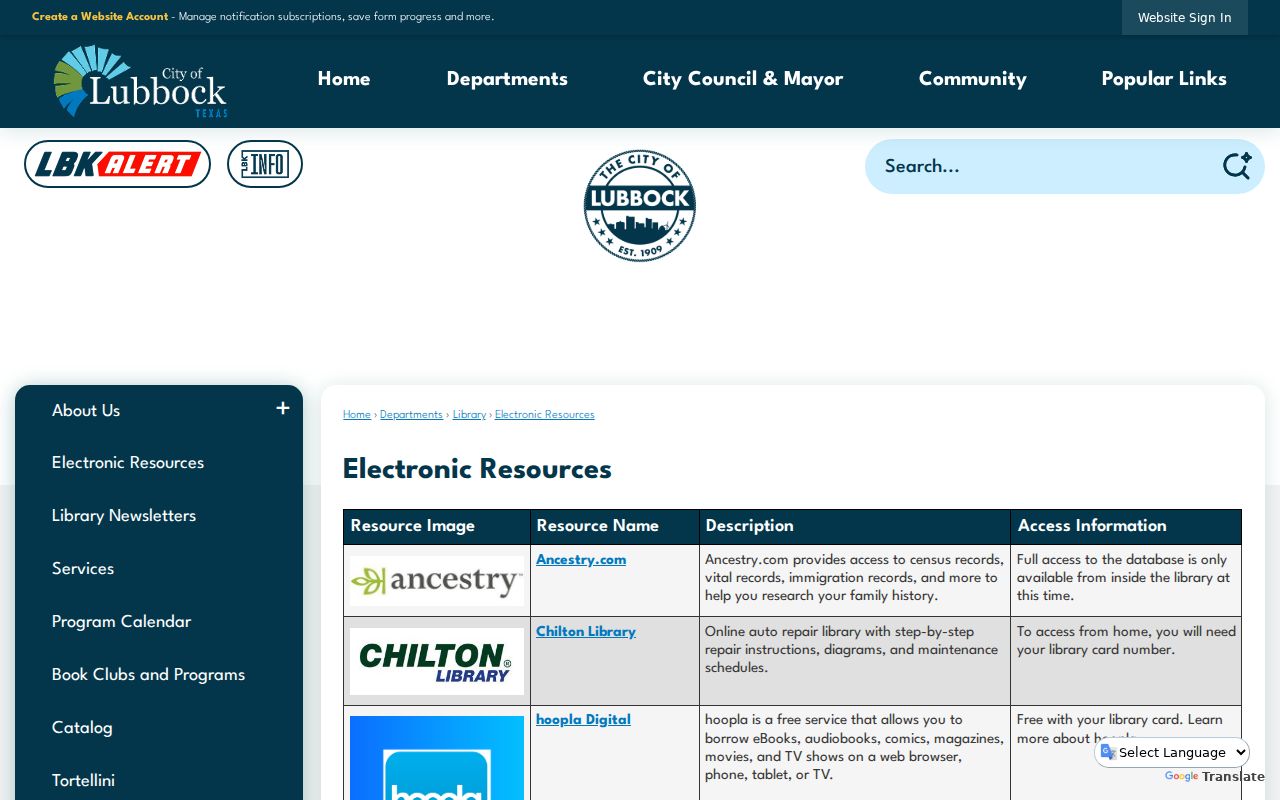
The library image reflects the local online starting point, while the shelf and genealogy desk remain important for directory volumes that have not been digitized.
South Plains Genealogical Society volunteers support the genealogy section at Mahon. The society began building its collection in 1961 and makes donated books, periodicals, microfilm, and CDs available to public researchers without membership. That is a useful human fallback when an older Lubbock city directory uses unfamiliar shorthand or a local surname appears under several forms.
Digital Paths to Lubbock City Directories
The Texas State Library city-directory guide points researchers toward state holdings and the Portal to Texas History, where a digitized item can be narrowed by place and time. It also explains why the request needs to state directory type, location, and years. The examined sources did not identify a direct official Portal item for each Lubbock volume, so online browsing should be followed by an edition check at the library or archive.

The state guide provides a route into catalog and collection searching, not a claim that every Lubbock directory year is available as a free scan.
The Portal to Texas History city-directory collection offers browse and search controls for digitized directories. Use the date and place filters, then compare any result’s publisher, city, and edition year against the local runs. Lubbock directory images can have different access paths from the physical books, which is why both the online collection and the local shelf matter.
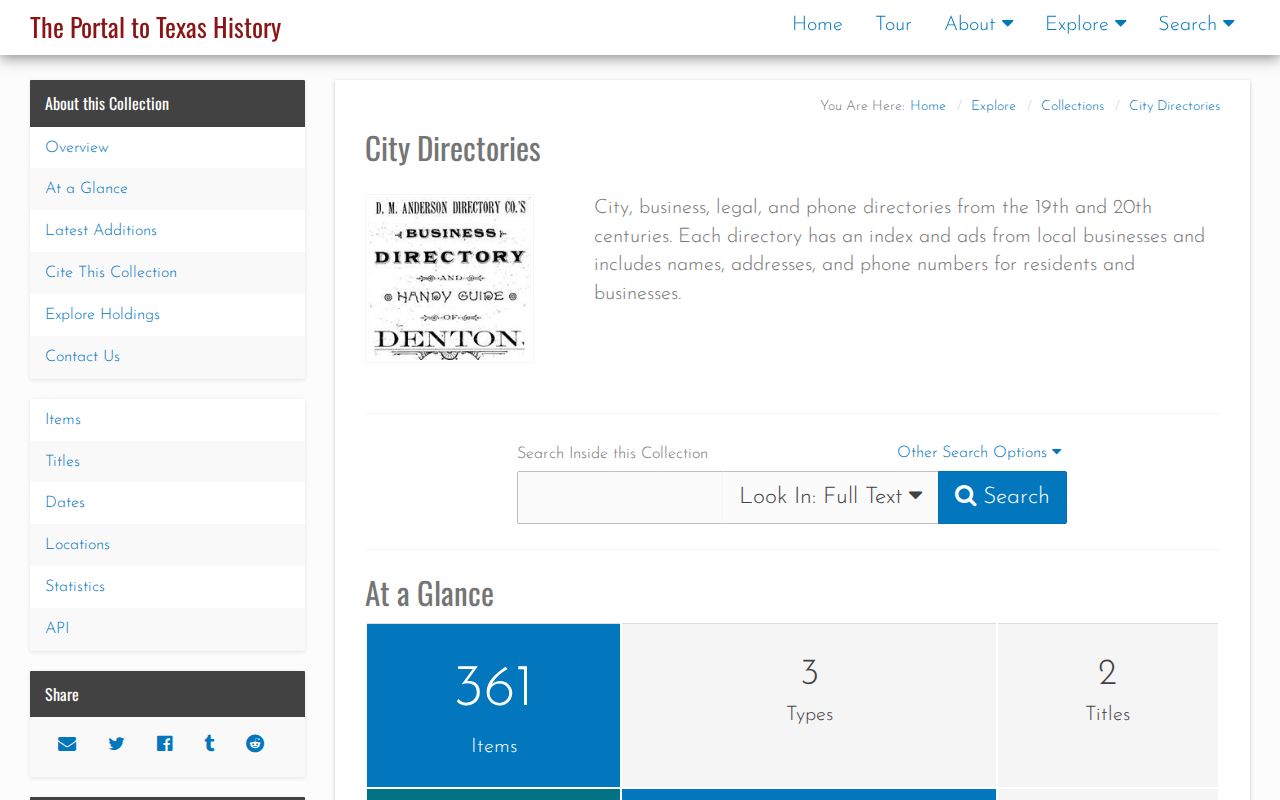
The collection interface is a useful discovery tool, but the directory title page and publication year remain the checks that tie a scan to the right Lubbock volume.
Lubbock Directory Companions at TTU
The Texas Tech Southwest Collection Lubbock reference list is a dense finding aid for the material that turns a bare directory entry into local history. It identifies city cemetery references, maps, lot surveys, neighborhood files, local government material, organizations, churches, landmarks, and regional media. The public repository is at 2805 15th Street. Its reference desk can be reached at (806) 742-9070, and the collection reports copy service at 20 cents per page plus tax with a five-dollar minimum for mail orders.
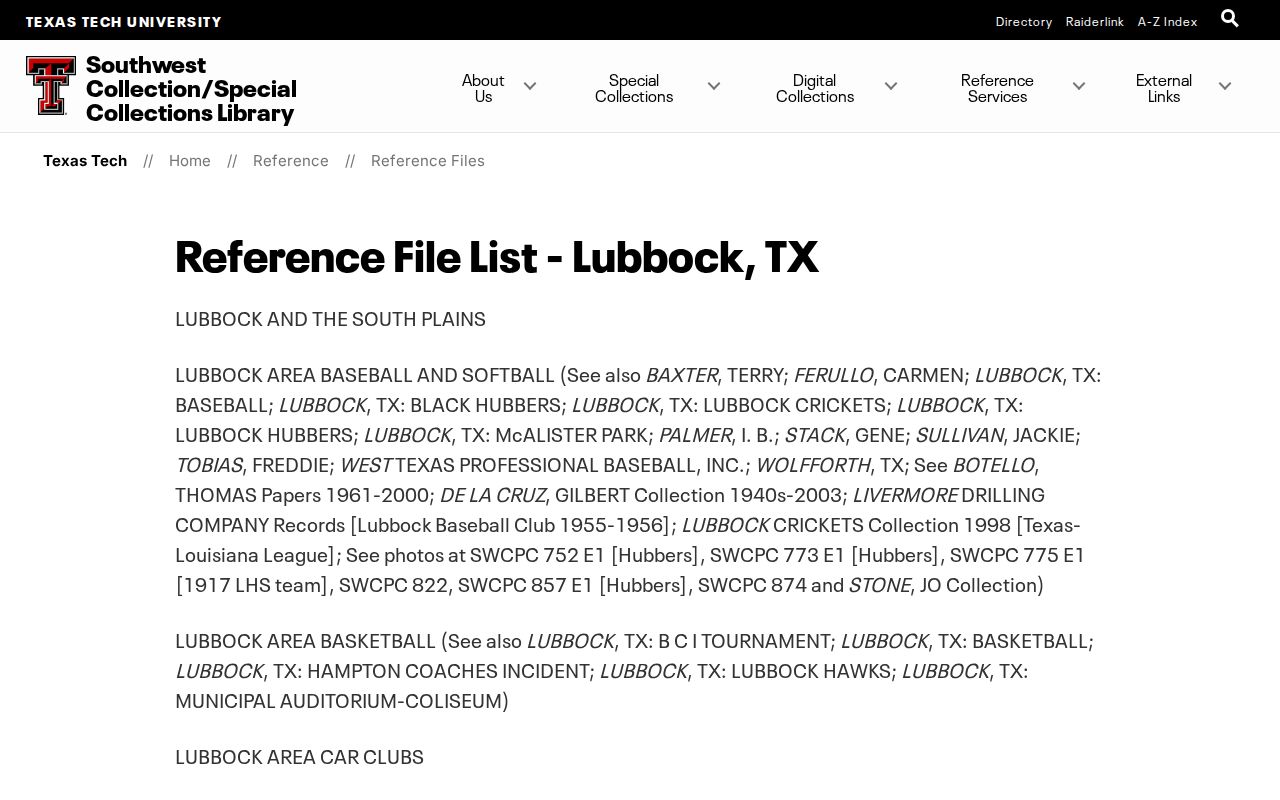
The reference list helps turn a directory address into a targeted folder, map, newspaper, or lot-survey request rather than a broad search for a person.
Yearbooks are another companion source. Lubbock Public Library has a digitized yearbook collection, although not all schools and years are included, and additional post-1977 yearbooks are available at Mahon. A yearbook can support a former-classmate search or confirm a school-time name. It does not establish a current address or a complete household.
Trace a Lubbock City Directory Household
A family-history trail works best when it starts with one verified entry and records its exact form. Keep the name variant, spouse or household note, occupation, address, and any edition-defined mark together. Move in annual or five-year steps, not by jumping from one distant decade to another. If the alphabetical listing vanishes, check the criss-cross address section, because it may identify another listed household member or a business at the same location.
- Find a surname and given-name variant in one confirmed Lubbock directory year and record the page.
- Move backward and forward through nearby editions, noting changes in street address, spouse notation, occupation, and name form.
- Test each address in the criss-cross section, using that year’s abbreviation key before interpreting marks.
- Pair a directory snapshot with the closest available 1930, 1940, or 1950 federal census schedule.
- Confirm the identity with two independent fields, then use a deed, vital record, obituary, or cemetery source as appropriate.
The 72-year release rule makes the 1950 federal schedule the latest fully released individual decennial census at the time of research. Use census schedules for historic household composition, not a current-person search. A former Lubbock resident found in a directory can be checked against a modern record through a Lubbock resident lookup when the research goal shifts from history to a current official source.
Lubbock City Directory Timeline and Gaps
The local directory timeline has a documented publisher handoff and a broader records-preservation context. The County Clerk’s FY2025–2026 archive plan says official county records have been computerized and automated since 2006, while archive work focuses on older microfilm, paper, handwritten and typed records. That distinction does not set a directory cutoff, but it explains why an older address trail often moves from a screen to a library, archive, or clerk counter.
- 1930–1972: verified Hudspeth Lubbock City Directory run.
- 1973–2003: verified R.L. Polk Lubbock City Directory run.
- September 9, 2024: Lubbock County approved its FY2025 records-management and archive plan.
For an address near an addition boundary, consult city maps with historical annexations by decade or ordinance and the official street-name and block-range materials. The sources do not establish a specific citywide street-renumbering year. Preserve both old and current spellings or numbers, then use lot, block, and subdivision details to bridge the difference.
Note: An online gap can reflect unscanned or re-indexed material, not proof that the underlying Lubbock record never existed.
Lubbock Directory Addresses on Sanborn Sheets
The Library of Congress 1940 Lubbock Sanborn atlas has 61 images and four skeleton maps. Start with its key and street index before selecting a sheet. The maps can show a building outline, use, materials, street and block numbers, boundaries, water features, and related physical context. They usually do not identify a resident, so use them beside a city directory entry rather than as a replacement for one.
The May 11, 1970 tornado is another important address-history divider. Texas Tech holds a 1970–1983 tornado collection with printed material, photos, slides, and accounts of damage and rebuilding. For a structure that changed, compare a Sanborn map, a directory address, a deed, a permit record, and local newspaper material instead of drawing a conclusion from one source.