
Lubbock Previous Residents by Era
A careful Lubbock address history has two layers. The ownership layer starts with the current appraisal account and runs backward through recorded instruments. The household layer uses dated directories and released census schedules to ask who was listed or enumerated there. City GIS and building records add geographic or construction context. Each source has a different time span and meaning, so a name in one should be confirmed against a separate record before being treated as the same person.
| Source | Years It Covers | Where Held | What It Shows |
|---|---|---|---|
| LCAD property account | Current tax years; historical start not stated | Online LCAD | Current owner, mailing and situs address, value, exemptions, legal description |
| County Clerk electronic records | Electronic automation since 2006; exact web cutoff not stated | EagleWeb and County Clerk counter | Recorded instruments, parties, dates, reception number, and legal description |
| County Clerk historical records | Pre-1974 records are a preservation priority | Courthouse archive and microfilm | Older grantor, grantee, and legal-description trail |
| Hudspeth and Polk directories | 1930–1972 and 1973–2003 | Mahon, TTU, and local collections | Dated occupant, business, and address listings |
| Federal census | Individual schedules publicly through 1950 | Census sources and library databases | Household at the enumeration date, not an annual record |
| Sanborn maps and permits | Sanborn: 1926, 1931, 1940, 1957; permit history varies | LOC, City CSS, PIA, and Building Safety | Structure, address context, or dated project evidence |
Start with the source that fits the question. A recent ownership question belongs with LCAD and the County Clerk. A household question from the middle of the twentieth century belongs with a directory and the closest released census. A building change needs a map, permit, and deed comparison rather than a guess based on its current appearance.
Start Lubbock Previous Residents With a Parcel
Lubbock Central Appraisal District is the present-day starting point for an address trail. Its basic search accepts a name or QuickRef, and its Advanced Search includes owner, street number range, street name, city, ZIP code, neighborhood, legal description, subdivision, block, tract or lot, and property ID fields. Save the property ID, situs address, owner name, mailing address, legal description, and lot or block details. These details connect a current street address to the wording that deeds and plats use.
The situs address is the physical location of the parcel. The owner mailing address is where tax notices go, which can be elsewhere in or outside Lubbock. A mailing address can be a useful clue for an owner, estate, trust, or business, but it is not proof that someone lives at the property. For spatial confirmation, City ParcelMap can show the address, parcel geometry, street name, subdivision, ZIP, City Limit, and Lubbock County layers. LCAD remains the stronger current ownership account because the city receives parcel uploads monthly.
Note: Preserve the legal description even when the Lubbock street number looks stable, because older recorded instruments may not use it.
Follow Lubbock Previous Residents in EagleWeb
The Lubbock County Clerk EagleWeb search is the official index route for the recorded ownership trail. Public Login, cookies, and JavaScript are part of the access path. The portal groups All Recordings or Filings, Land Records, assumed names, marriage certificates, death certificates, and birth certificates. Its online record is a convenience copy, not the certified repository, and the Clerk warns that statutory redactions and omissions may apply. Use the counter when a complete official record or older material is needed.
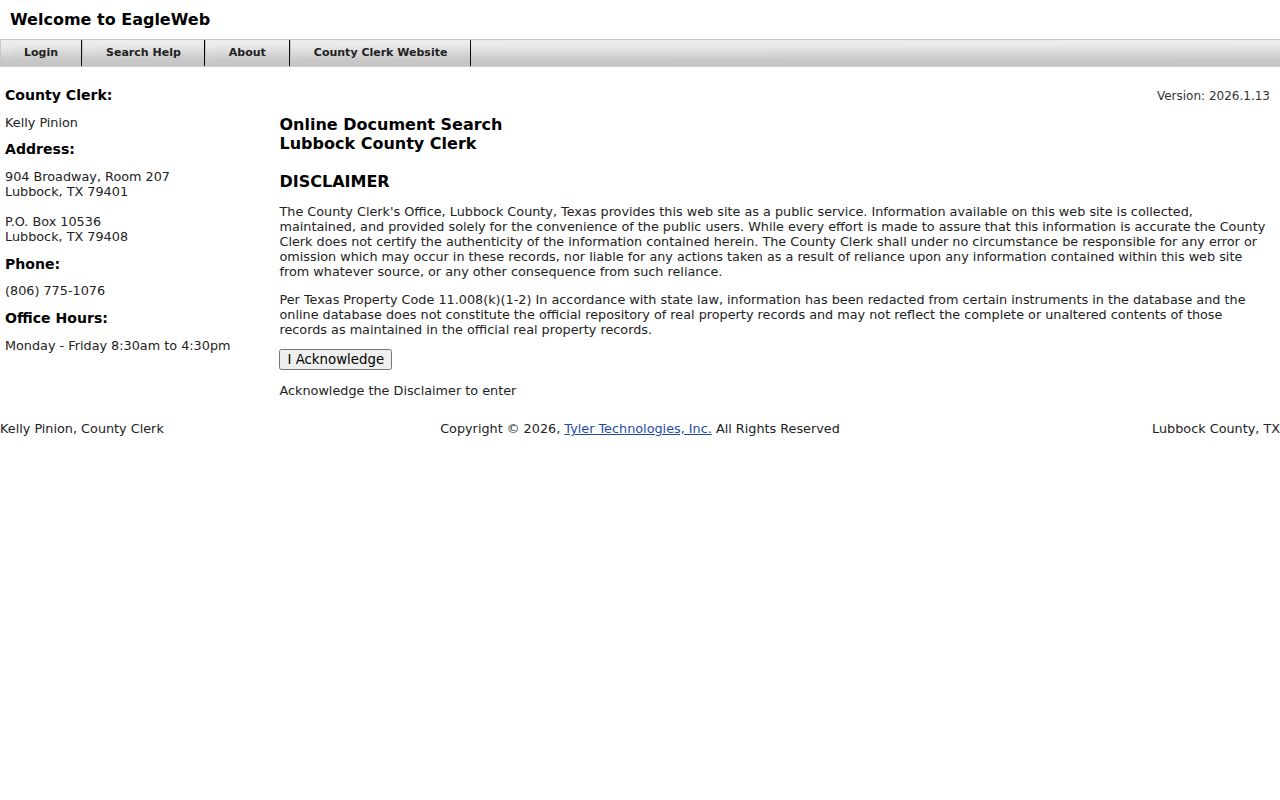
The EagleWeb entry screen establishes the public route, but a researcher still creates the chain by reading each instrument and searching the prior party.
- Pull the current owner and legal description from LCAD, along with any property ID and visible deed reference.
- Search that owner as a grantee in EagleWeb, then narrow with a date range or document type when needed.
- Open or obtain the purchase instrument and record the seller, recording date, reception number, legal description, and prior reference.
- Search that seller as a grantee in earlier records, then repeat the same sequence backward.
- When the online index does not reach the needed instrument, use the County Clerk counter, deed books, microfilm, archive request, or copy route.
County sources say records have been computerized and automated since 2006, while preservation work prioritizes pre-1974 material. Neither statement gives an exact EagleWeb start year. Use those facts as an access warning, not as a claim that every older deed is absent from the portal.
Lubbock Deed Terms for Past Residents
EagleWeb search help confirms the key ways to narrow a deed search: Grantor, Grantee, a date range, reception number, and selected document types. More search information narrows a result set. The help page does not publish a guaranteed one-click chain of title or the full current document-type menu. Build a written sequence from the recorded fields instead of assuming that party names alone identify a property.
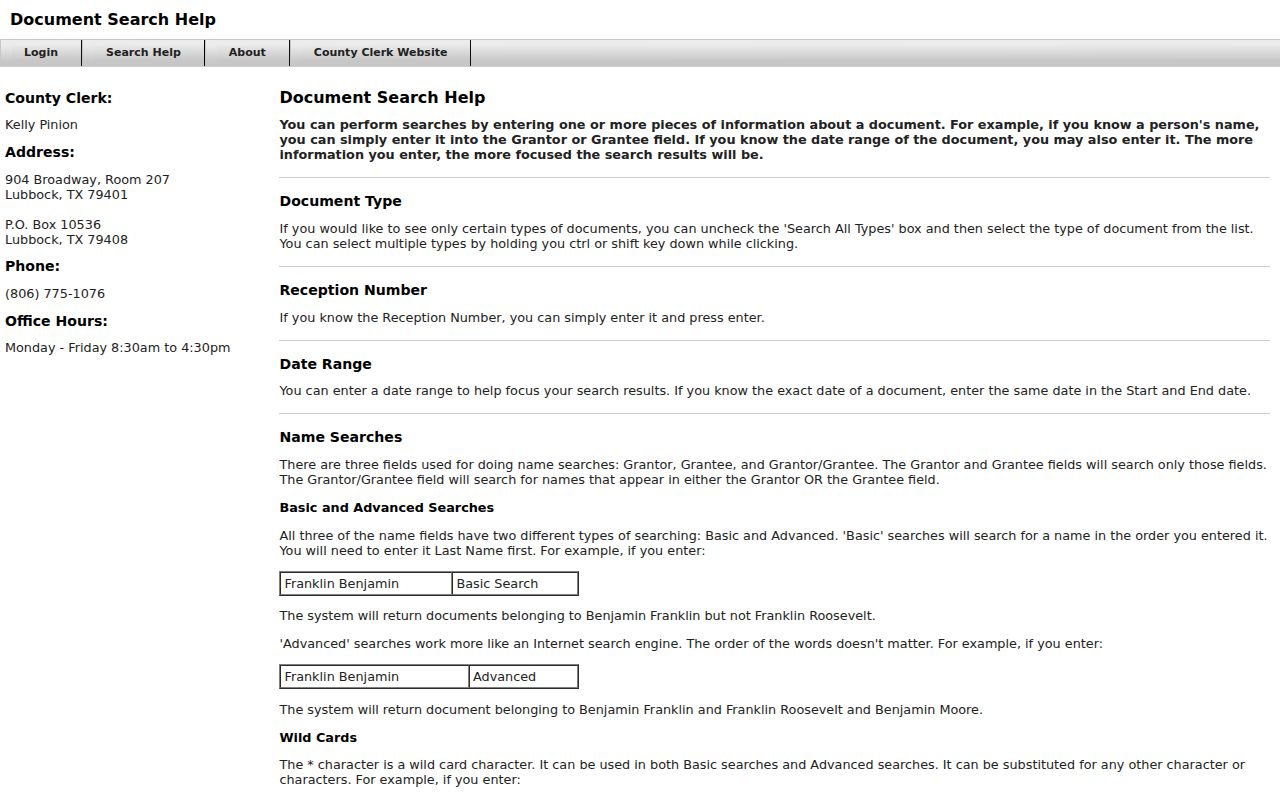
The help screen supports a backward party-and-date search; the legal description is what keeps the trail tied to the same Lubbock parcel when an address changes.
- Grantor
- The party transferring an interest in a recorded instrument, often the seller in a deed transaction.
- Grantee
- The party receiving an interest, often the buyer whose earlier purchase can lead to the prior transfer.
- Chain of title
- A researcher-built sequence of recorded instruments connecting one interest in a parcel to an earlier one.
- Legal description
- Lot, block, subdivision, abstract, tract, or metes-and-bounds wording that identifies land beyond a street number.
If a document needs a certified copy, identify the reception number or book and page, instrument type, parties, and year in the request. EagleWeb does not publish a current image-download price or subscription tier in the inspected official material.
Lubbock Previous Residents and the Archive Boundary
Lubbock County’s FY2025–2026 records-management and archive plan gives a concrete reason older deeds can take extra work. The plan says the Clerk is digitizing older microfilm and paper, re-indexing handwritten and typed books, restoring fading Photostat volumes, and importing newly created data into the electronic system. Archive funds can be spent on records filed before 1974. That is an insider access point: an online miss may mean the book needs counter, microfilm, or archive assistance, not that the address has no history.
Ask the County Clerk archive staff for the relevant book series, year, and whether the material is restored, indexed, or awaiting import. The Clerk is at 904 Broadway, Room 207, Lubbock, TX 79401, with a listed phone of (806) 775-1076 and Monday through Friday hours of 8:30 a.m. to 4:30 p.m. Mail requests can use P.O. Box 10536, Lubbock, TX 79408. The archive route is especially important before a directory or census name is attached to an early address.
Bridge Lubbock Past Addresses by Lot
A current street label may not be the best key for a historic Lubbock property. City maps include historical annexations by decade and ordinance plus official street names and block ranges. TTU’s Lubbock Lot Surveys cover the 1920s through 1960s and document additions or modified streets and blocks in Original Town, Overton, and McCrummens. Use the subdivision, lot, and block from a deed with these materials before deciding that two different address forms describe different places.
No official source reviewed establishes a citywide Lubbock street-renumbering year. Keep the old spelling or number in the research log and search it alongside the current form. For a plat with no modern street number, use the legal description in LCAD, turn on subdivision and parcel layers in City GIS, and consult the County Clerk or TTU map materials. A map click is a locator, not title evidence.
Lubbock Maps for Previous Address Clues
The Library of Congress 1940 Lubbock Sanborn atlas contains 61 images plus four skeleton maps. Begin with the street index and key, then select the sheet for the address range. Sanborn maps can show a building’s outline, size, shape, materials, use, street and block numbers, property boundaries, and water or fire-service details. They usually do not name a household, so they work as an address-continuity tool beside deeds and city directories.
The verified bibliography also identifies Lubbock Sanborn editions from 1926, 1931, and 1957. Compare a map to permit and deed dates when a structure was altered or replaced. The May 11, 1970 tornado produced a Texas Tech collection with records from 1970 through 1983, including material about damage and rebuilding. It can be an important divider in a property’s history, but it should not be used to infer an occupant.
Pair Lubbock Previous Residents With Census
Ownership is only part of the answer to who lived here before. Hudspeth directories cover 1930–1972 and Polk directories cover 1973–2003, offering dated listings for occupants, businesses, and addresses. A criss-cross section may lead from the address to a listed name even when the alphabetical section is hard to interpret. The historical volumes themselves, their entry conventions, and shelf access are detailed with the Lubbock city directory collections.
- Choose the directory year nearest to the address event or deed date and record the printed name, address, and page.
- Check the next available directory forward or backward for a move, name variant, spouse notation, or business change.
- Use the criss-cross section to test the address and read that edition’s abbreviation key before interpreting marks.
- Pair the directory with the nearest released 1930, 1940, or 1950 census schedule.
- Use an obituary, cemetery microfilm, or probate record only as a separate historical confirmation of the person or family connection.
The 72-year rule makes 1950 the latest fully released individual federal census schedule in the research. Census and directory entries are snapshots. A listed head of household is not proof that every resident was enumerated, and an absent name can reflect a move, a different listing practice, or an incomplete volume.
Lubbock Previous Residents, Permits, and Endpoints
City Building Safety’s Citizen Self Service portal accepts a permit number, project, or address. The published interface shows permit number, project, address, type, status, and attention reason. A permit can date construction, repair, or a project, but it does not prove that an owner or applicant lived there. When a record is not visible, the City directs requestors to use its Public Information Act route. Sealed plans can require an appointment for viewing.
Obituaries and probate or heirship filings can close a historic trail by identifying a death, executor, spouse, children, or representative. They are sensitive sources and may have limits. For historical and family research, use them to confirm a dated relationship to the address, never to make an assumption about a living person’s present location.
Use Lubbock Past Resident Records Carefully
Past-resident research is best kept to house history, family history, estate questions, and local-history curiosity. Lubbock records describe different relationships to a place at different dates. A parcel owner is not automatically every resident, a directory listing is not an occupancy census, and a mailing address is not a current-location statement. Preserve the source and date with every conclusion.
Lawful use. Use Lubbock address history for legitimate personal research. Do not use names, addresses, or records to stalk, harass, or harm any person.
City GIS, LCAD, EagleWeb, Mahon, and the Southwest Collection all have different roles. The best backward trail keeps their limits intact and returns to the appropriate custodian when an online result does not settle the question.